By Lee · October 6, 2026
How to Help Your Child Focus: Simple Attention-Building Activities for Ages 3–6
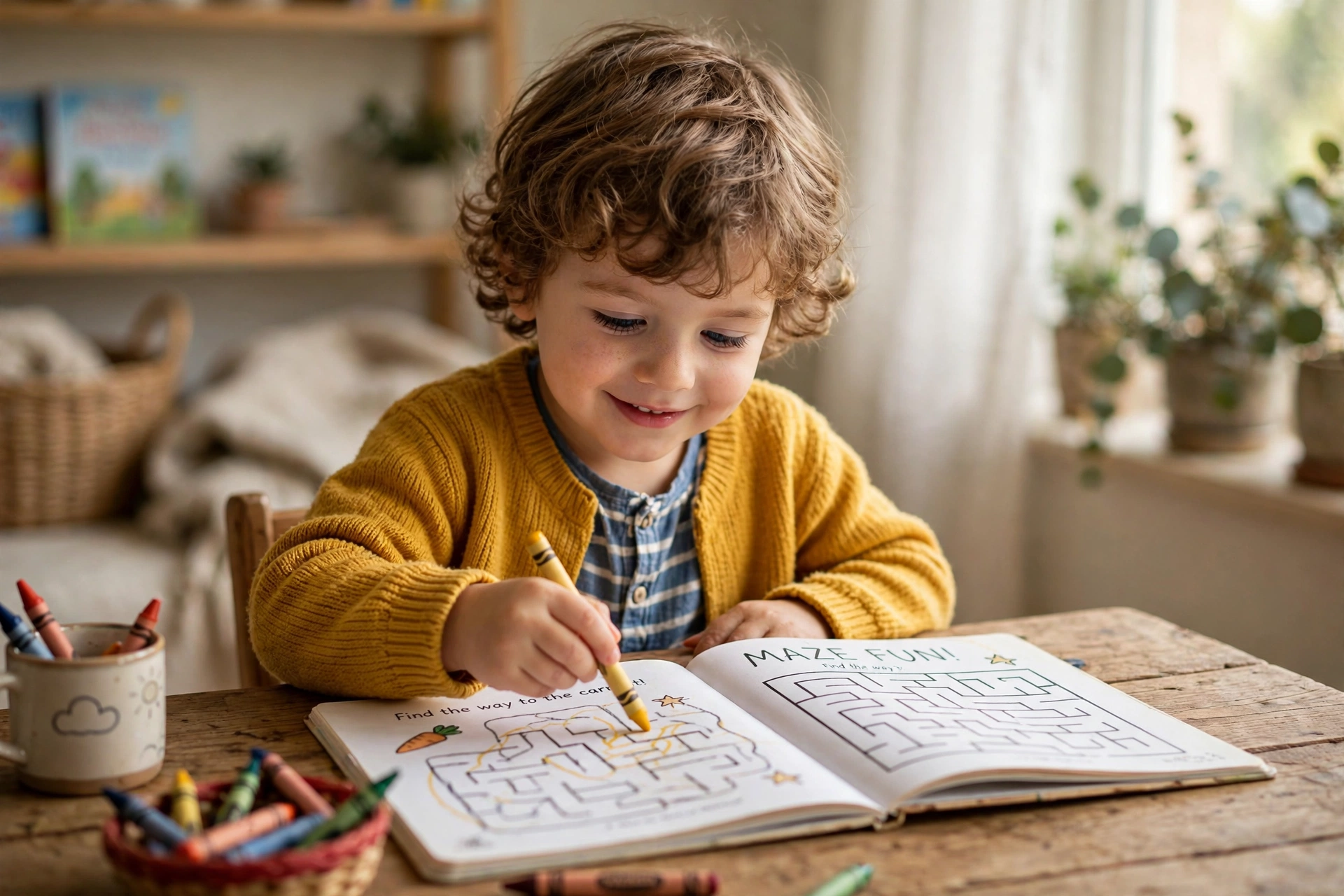
If you have ever watched your four-year-old abandon a puzzle after ninety seconds to chase a dust mote across the room, you are not alone — and your child is not broken. Wriggly, distractible, gloriously curious: that is simply what young brains look like from the outside.
Here is the good news most parents never hear: focus is a skill, not a personality trait. Children are not born with good attention or bad attention. Attention is built, gradually, the same way muscles are built — through regular practice at the right level of challenge. And the activities that build it best do not look like drills. They look like play.
What “paying attention” actually is
When researchers talk about focus in young children, they are really talking about executive functions — the brain’s management system. Three of them matter most in the early years:
- Working memory — holding an instruction in mind while acting on it (“colour all the circles red, then the squares blue”).
- Inhibitory control — resisting the impulse to do the fun wrong thing (not shouting out, not grabbing, waiting a turn).
- Cognitive flexibility — switching gears when the rules change (“now we’re sorting by shape instead of colour”).
These skills live largely in the prefrontal cortex, which is still under construction well into a person’s twenties. So when your five-year-old cannot sit through a twenty-minute activity, that is not a failure of character or parenting — it is neurology. A rough rule of thumb many educators use is two to five minutes of sustained focus per year of age on a single task. A four-year-old giving you eight solid minutes on a maze is doing brilliantly.
The encouraging part? These skills respond to practice. In a widely cited review in the journal Science, Adele Diamond and Kathleen Lee examined the evidence on interventions for children aged 4 to 12 and found that diverse everyday activities — games, physical play, yoga, and mindfulness — measurably improved children’s executive functions. The common thread across every successful program was repeated practice that gradually increased the challenge. A later meta-analysis of 90 studies confirmed it is genuinely possible to foster these skills in childhood, with mindfulness-style practices showing moderate benefits for typically developing children.
In plain language: you do not need special equipment or expensive programs. You need playful activities, done regularly, that get a little bit harder over time.
Quick takeaway: Attention grows the way muscles grow — through regular, gradually harder practice, not through being told to “concentrate harder.”
Six simple activities that build focus at home
1. Mazes — the original focus workout
A maze asks a child to do several hard things at once: plan a route, track it with their eyes, guide their hand along it, and resist the urge to scribble straight through the walls. Start with wide, simple mazes and work up to trickier ones as your child succeeds — that gradual increase in difficulty is exactly what the research says matters most. Our free printable mazes are organised from easy to challenging for this reason.
2. Spot-the-difference — sustained attention in disguise
Comparing two nearly identical pictures and hunting for what changed is one of the purest attention exercises there is. It trains visual scanning and sustained focus: the child must look carefully, hold the first image in memory, and check it against the second. Try our spot-the-difference sheets — and resist the urge to point out the answers. The searching is the exercise.
3. Puzzles and building toys — practising persistence
Jigsaws, blocks, and construction sets teach a child to work toward a goal through frustration. The trick is matching the challenge to the child: too easy and there is nothing to practise; too hard and they quit. Aim for the sweet spot where they need a little help but can mostly do it themselves. Finishing something hard is also one of the fastest ways to build a child’s confidence.
4. “Simon Says” and listening games — training the brakes
Games with stop-and-go rules are brilliant for inhibitory control. In Simon Says, the child must listen, decide, and — hardest of all — not move when Simon didn’t say so. Musical statues, red-light-green-light, and “freeze dance” all work the same muscle. These cost nothing and can fill a rainy afternoon.
5. Colouring with a mission — following rules on purpose
Plain colouring is lovely, but colouring with a rule turns it into focus training: “colour every circle red and every triangle blue,” or “stay inside the lines on this one.” Following a rule while doing something enjoyable is executive-function practice wearing a party hat. Our connect-the-dots pages work the same way — there is a right order, and finding it takes concentration.
6. Outdoor, unstructured play — the reset button
It sounds counterintuitive, but running wild outside helps children focus later. Physical activity supports the brain systems that regulate attention, and researchers have consistently found that time in green, natural settings is linked to better concentration in children. A trip to the park is not a break from learning — for a young child, movement is part of how the brain learns to settle.
Set them up to succeed
The activity matters, but so does the setup. A few small things make a big difference:
- Keep sessions short. Ten focused minutes beats thirty distracted ones. Stop while it is still fun.
- Cut the competition for their attention. Screens off (even in the background), toys for the current activity only. A quiet table is worth more than any workbook.
- Build a little routine. “After lunch we do a puzzle” turns focus time into a habit rather than a negotiation.
- Praise the effort, not the outcome. “You stuck with that tricky maze!” teaches a child that persistence is the point — which makes them more willing to persist next time.
- Model it. Children copy what they see. If they watch you put your phone down and concentrate on something, they learn that focus is simply what people do.
A note on expectations
Every child develops at their own pace, and attention is no exception — some children are naturally dreamier, some naturally intense, and both are normal. The activities above are educational ideas for home, not diagnostic tools. If you have ongoing concerns about your child’s attention, speak with your paediatrician or your child’s educator; they can tell the difference between typical development and something worth a closer look.
And remember the long game. You are not trying to produce a child who sits still on command — you are helping build a brain that can choose what to pay attention to. That is a skill that will serve them in every classroom, every friendship, and every job they ever have. Ninety seconds on a puzzle today, eight minutes on a maze next month. That is how focus grows.
Sources
- Diamond, A. & Lee, K. (2011). Interventions shown to aid executive function development in children 4 to 12 years old. Science, 333(6045), 959–964. PubMed
- Takacs, Z. K. & Kassai, R. (2019). The efficacy of different interventions to foster children’s executive function skills: A series of meta-analyses. Psychological Bulletin, 145(7), 653–697. PubMed
Keep the learning going — Looking for more hands-on fun? Download free printable mazes, spot-the-difference, and colouring pages: Explore free worksheets — or book a free tutoring consultation.